
Patterns of Wonder
Patterns of Wonder invites PreK–1 emergent writers to notice and play with the conventions of language through inquiry-based, standards-aligned lessons that take just 10 minutes a day. Written by Whitney La Rocca and Jeff Anderson, it includes ready-to-use lesson sets, a scaffolded approach for young learners, and over 200 picture book recommendations to spark classroom conversation.
Pre-K to 1
Pre-K to 1

Patterns of Wonder en español
Patterns of Wonder en español extends the same inquiry-based, play-driven approach to PreK–1 emergent bilingual writers, inviting them to notice and experiment with the conventions of Spanish. Written by Caroline Sweet, Whitney La Rocca, and Jeff Anderson, it includes lessons built on the Patterns of Wonder process along with over 100 culturally and linguistically diverse picture book recommendations.
Pre-K to 1
Elementary

Patterns of Power
Patterns of Power invites grades 1–5 writers to notice and build off the conventions of the English language through inquiry-based, standards-aligned lessons that take just 10 minutes a day. Written by Jeff Anderson and Whitney La Rocca, it includes over 70 ready-to-use lesson sets built from authentic mentor texts and can be adapted across five grade levels.
GradeS 1-5

Patterns of Revision, Grade 3
Patterns of Revision, Grade 3 gives teachers concrete, classroom-tested lessons in sentence combining to help third graders revise with purpose rather than just proofread. Written by Whitney La Rocca and Jeff Anderson, it builds routines around noticing, talking through, and combining sentences to elevate student writing.
Grade 3

Patterns of Power Plus
Patterns of Power PLUS translates the Patterns of Power process into full-year classroom kits, with a separate kit for each grade level, 1 through 5. Each kit pairs the same invitational grammar instruction with ready-to-use classroom materials, so teachers can put the approach to work without building it from scratch.
GradeS 1-5

Patterns of Revision, Grade 4
Patterns of Revision, Grade 4 gives teachers concrete, classroom-tested lessons in sentence combining to help fourth graders revise with purpose rather than just proofread. Written by Whitney La Rocca and Jeff Anderson, it works as a standalone resource or a supplement to Patterns of Power, Grades 1-5 and Patterns of Power PLUS, Grade 4.
Grade 4

Patterns of Power en español
Patterns of Power en español adapts the same inquiry-based approach for grades 1–5 bilingual writers, inviting them to notice the conventions of the Spanish language through short, authentic texts. Written by Jeff Anderson and Caroline Sweet, it includes ready-to-use lesson sets built from diverse Spanish mentor texts.
GradeS 1-5

Patterns of Revision, Grade 5
Patterns of Revision, Grade 5 gives teachers concrete, classroom-tested lessons in sentence combining to help fifth graders revise with purpose rather than just proofread. Written by Whitney La Rocca and Jeff Anderson, it builds routines around noticing, talking through, and combining sentences to elevate student writing.
Grade 5
Secondary

Patterns of Power, Grades 6-8
Patterns of Power, Grades 6–8 extends the same inquiry-based approach to adolescent writers, inviting middle schoolers to notice and build off the conventions of language through short, authentic texts. Written by Jeff Anderson, Travis Leech, and Melinda Clark, it includes ready-to-use lesson sets, real classroom examples, and musical soundtrack suggestions to bring energy to grammar instruction.
Grades 6-8
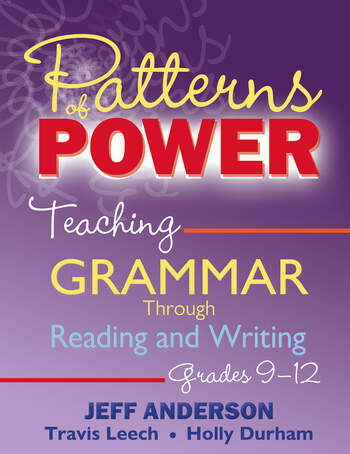
Patterns of Power, Grades 9-12
Patterns of Power, Grades 9–12 shifts high school grammar instruction away from right-or-wrong correction and toward exploring how conventions create meaning, purpose, and effect in authentic texts. Written by Jeff Anderson, Travis Leech, and Holly Durham, it includes quick-reference guides, reading-instruction applications, and implementation supports built for the high school classroom.
Grades 9-12

Patterns of Analysis
Patterns of Analysis connects grammar instruction directly to literary analysis, giving students concrete entry points into interpreting complex texts rather than relying on formulaic responses. Written by Holly Durham, it helps students move from noticing grammatical patterns to developing their own insightful, evidence-based interpretations.
Grades 6-12

Patterns of Revision, Grade 6
Patterns of Revision, Grade 6 gives teachers concrete, classroom-tested lessons in sentence combining to help sixth graders revise with purpose rather than just proofread. Written by Travis Leech and Jeff Anderson, it works as a standalone resource or a supplement to Patterns of Power, Grades 6-8.
Grade 6

Patterns of Revision, Grade 7
Patterns of Revision, Grade 7 gives teachers concrete, classroom-tested lessons in sentence combining to help seventh graders revise with purpose rather than just proofread. Written by Travis Leech and Jeff Anderson, it builds routines around noticing, talking through, and combining sentences to elevate student writing.
Grade 7

Patterns of Revision, Grade 8
Patterns of Revision, Grade 8 gives teachers concrete, classroom-tested lessons in sentence combining to help eighth graders revise with purpose rather than just proofread. Written by Travis Leech and Jeff Anderson, it builds routines around noticing, talking through, and combining sentences to elevate student writing.
Grade 8

Classic Texts in Contemporary Classrooms
Classic Texts in Contemporary Classrooms helps teachers make canonical novels feel urgent to today's students by pairing each text with contemporary thematic lenses students already care about. Written by Travis Leech, Sasha L. Jaramillo, and Tony Perez, it offers chapter-by-chapter frameworks, paired texts, and writing opportunities built around titles like To Kill a Mockingbird, The Giver, and Of Mice and Men.
Grades 6-12